-->

Theme Layout

Boxed or Wide or Framed

Theme Translation

Display Featured Slider

Featured Slider Styles

Display Grid Slider

Grid Slider Styles

Display Trending Posts

Display Author Bio

Display Instagram Footer

Dark or Light Style

Powered by Blogger.

Comments system

top navigation

Labels

Pages

Menu

Pages - Menu

Popular Posts

Blog Archive

Showing posts with label Dakota Access Pipeline. Show all posts
‘I Was Born Free’ - Red Fawn and State-Sponsored Sexual Assault of Native Women at Standing Rock

‘I Was Born Free’ - Red Fawn and State-Sponsored Sexual Assault of Native Women at Standing Rock


By Jacqueline Keeler

Red Fawn Fallis behind screen at her sentencing on July 11, 2018
Photo : Cempoalli Twenny Facebook page

On Wednesday July 11, Red Fawn Fallis, 39, Lakota and the most high profile water protector charged with a felony at Standing Rock was sentenced to 57 months in federal prison with 18 months for time served. Her legal team will have 14 days to appeal.

Fallis was found guilty of one count of civil disorder and one count of possession of a firearm and ammunition by a felon. In the video of her arrest on October 27, 2016, Fallis, a medic at the camp, can be seen arriving on an ATV where a line of police in riot gear are faced off with water protectors. The wall of men parts and a deputy tackles her saying he heard her shouting “water is life”.

Behind the line of armored law enforcement, five men pile on top of her. As they pin her arm behind her back and with their knees hold her legs down, the gun which is not visible in the video because of all the men on top of her can be heard discharging three times, apparently into the ground.

It was revealed in leaked documents reported by The Intercept in December, her boyfriend Heath Harmon, 46,  from the Fort Berthold reservation was an informant working for the FBI and that the gun Fallis allegedly fired during her arrest belonged to him. 

According to a Motion to Compel Discovery filed by her defense attorneys Harmon “seduced Ms. Fallis and initiated an intimate, albeit duplicitous relationship with her. He spent the majority of the 48-hour period prior to Ms. Fallis’s arrest with her and had access to her and her belongings… He used their romantic relationship to rely upon her as an unwitting source of information for informant activities.” 

Family members of Red Fawn told me the FBI plant literally “jacketed” her by putting his jacket with the gun in it on her right before her arrest and planting items in her backpack. In leaked police drone footage shared by The Intercept, Harmon can be seen leaving on her ATV just 20 seconds after his purported girlfriend’s arrest. Seconds later, he spoke to a Dakota water protector (who asked not to be identified) and did not mention Red Fawn’s violent arrest. In his leaked interview with Alcohol, Tobacco and Firearms he claims he immediately returned to camp to collect all of her possessions and return them to her family on Standing Rock. This after his girlfriend was tackled by several large men for free speech in front of him.

After giving false and contradictory testimony to law enforcement regarding the gun, he continued the pretense of being her boyfriend even after she was arrested. In leaked audio of their phone calls, Fallis can be heard tearfully confiding, unknowingly, to him, a paid infiltrator, her fears and desire not to serve time for something she did not do. 

In 2012, it was revealed that in Britain London’s Metropolitan police was running a top secret decades-long infiltration program, the Special Demonstration Squad, of progressive groups that led to long-term sexual relationships with women being spied upon. Some of these women gave birth to children by undercover police officers who never revealed their true identities. One of those women identified as ‘Jacqui’ later settled with the Metropolitan police for £425,000 or about $560,000. She described the experience to The Guardian as being “raped by the state” and was deeply traumatized after discovering the truth.

“I had a spy who was being paid by the government to spy on me,” Jacqui told the press, ” to the extent that he watched me give birth, so he saw every intimate part of me.”

Arrest of Red Fawn Fallis at Standing Rock, October 27, 2016

Native American women have long been the target of violence both by the United States government though total wars waged against their nations to gain access to homelands and through structural violence in the resulting colonial society that marginalizes them. 

A widely quoted 2010 Department of Justice report found Native women experienced rape and murder at rates nearly 2 and half times that of other American women. In some counties, the murder rate is 9 times. Criminal database statistics find that 70 percent of Native women’s reported attackers are men not of their race—most being white men. Most American women are primarily assaulted by men of their own race. More data is needed to address the vulnerable picture this paints of Native women in America.

At the hearing, Red Dawn Foster, Lakota/Diné candidate running for the South Dakota state senate and a hunka sister (adopted in the traditional Lakota way) of Red Fawn recounted to the judge Fallis’ history of abusive relationships that made her susceptible to manipulation by someone like Harmon.

U.S. District of North Dakota Chief Judge Hovland granted Fallis permission to wear civilian clothing at the nearly 6-hour hearing.  She appeared shackled and wearing a traditional ribbon dress. 

It was however, partly Hovland’s refusal to allow for further discovery into Harmon’s role in the defendant’s arrest (and of pipeline owner Energy Transfer Partners' security contractors like TigerSwan who he determined were not part of the prosecution) that forced the defense to agree to a non-cooperating plea deal in late January. Under the deal, the most serious charge against her of firing an weapon at law enforcement was dropped. That charge could have put her in prison for 30 years. He also refused to allow any defense based on treaties that were violated by the building of the pipeline.

At the prayer after her sentencing was postponed in June, friends, family, attorneys and supporters of Red Fawn gathered for prayer in a Bismarck hotel meeting room. Her hunka uncle and University of Colorado professor Glenn Morris and attorney, spoke to those gathered telling them that he had spoken to his niece that morning. She has already been in custody for more than 20 months. 

“She told me,” he said, “‘I’m a wild Oglala. I was born free, I will live free and I will die free. And I know what day this is.’”

That day was the 142nd anniversary of what the Lakota call “Victory Day”, the Battle of Greasy Grass, or as the Americans call it the Battle of the Little Big Horn. In 1874, it was in search of gold that Custer led 1,000 men into the Black Hills in violation of the Fort Laramie treaty. Since then mines on Lakota land have produced according to some estimates nearly 10 percent of the world’s gold. In 2016, the battle was the transportation of heavy crude from the Bakken through unceded Lakota treaty lands which potentially endangered Lakota communities and millions of Americans downriver that precipitated the Dakota Access pipeline protests at Standing Rock.

It would seem with Fallis and several other Standing Rock “water protectors” (as protestors preferred to be called) still facing felony charges the battle has never really ended between the Lakota, their allies, and the American government.

Continue Reading
jfkeeler
0 Comments

You Might Also Like

Standing Rock & Sovereignty

Standing Rock & Sovereignty


Last night, I spoke at a 350PDX panel on Standing Rock and was asked to summarize what Standing Rock means to me and what my "lessons learned" were. I recalled a statement about Standing Rock made by my friend Joleen Brown (Oglala Lakota), editor of Native Hoop Magazine: "Even after everything they did to us—how they tried to damage us to make us lesser than we were...that we can still make a stand like this? When you see the two cultures facing off, I am so proud. You can clearly see which is the better culture."

I called Standing Rock a pilgrimage and I truly believe this to be true. A pilgrimage of heart and mind and a form of as we Dakota say "of voting with our feet." Everyone who is going there is casting a vote for the kind of society—world, even—they want to see and be a part of.

But it is also about sovereignty. And why does honoring the sovereignty matter? The sovereignty of the Great Sioux Nation or as we call it, the Oceti Sakowin (Seven Council Fires) and of the Standing Rock Sioux Tribe? Beyond the fact that without the sovereignty of our nations, treaties have no validity, diminishing, sidelining and/or co-opting our nation's sovereignty is no small thing.

Sovereignty cannot reside in a cult of personality—it must reside in systems that are accountable and transparent to all the people. The Standing Rock Sioux Tribe has methods of being held accountable (see here) but charismatic personalities do not. See the pictogram (right) for the problems with leadership vested solely in an individual and not an agreed-upon system of checks and balances clearly accountable to the people.

I posted these Facebook posts that explain my take on the maligning of Standing Rock Sioux tribal chairman Dave Archambault II:


Our people were not organized as feudal societies in Europe were with an autocratic leader who enforces his will through violence against his own people. Lakota/Dakota people were organized through specific respect relationships embodied in our kinship system. This was the main government we possessed. Disrespecting, ignoring and sidelining the leadership of elders and respect relatives is simply culturally alien to our culture, it is colonial in nature.

As my great-great aunt, Dakota ethnologist Ella Deloria noted in her 1944 book "Speaking of Indians":
"For the most part, then, everyone had his part to play and played it for the sake of his honor, all kinship duties, obligations, privileges, and honoring being reciprocal. One got as well as gave. Thus kinship had everybody in a fast net of interpersonal responsibility and made everybody like it, because its rewards were pleasant. There were fewer rebels against the system than you might think, since, as I have said, social standing and reputation hinged on it. Only those who kept the rules consistently and glad- good citizens of society, meaning persons of integrity and reliability. And that was practically all the government there was. It was what men lived by."
The use of colonial attitudes in the reemergence of the Oceti Sakowin would signal a very different nation or oyate than what we once were. Fundamentally different—in fact, not Dakota or Lakota, anymore. It would be a nation that would be some product of colonization. A change of this nature to our identity as people would have to be the result of a calm and reasoned discussion and be agreed upon by all the people of the Oceti Sakowin.

Which leads us to another fundamental aspect of Lakota/Dakota culture: consensus. We are not only not led by autocrats or charismatic leadership that makes its own rules, but we are ruled by consensus, a long, difficult but culturally-relevant process. Change either of these and you have a different people—a people who are no longer Lakota or Dakota except in name.

It saddens me that there is such division. Opening my email and I see a daily news brief from Grist and the lead story is about the infighting arising at Standing Rock. Once again, I turn to my great-great aunt's recollections of our kinship system to seek a remedy for this that is grounded in our culture and the strengths that it gave us a people whose leaders (who were a product of this system and utterly accountable to it) are admired and known the world over. Here she explains what she calls  "the kinship appeal":

"The kinship appeal was always a compelling force in any situation. If two normally decent acquaintances quarreled, for instance—and of course if they were acquaintances they were social relatives outsiders were deeply concerned over it until it was straightened out. The 'good men' felt it incumbent on them to restore peace and order by appealing to the quarreling ones through kinship. Peace is implied by the very name of the people, Odakota, a state or condition of peace; the 'O' is a locative prefix. 
'We Dakotas love peace within our borders. Peacemaking is our heritage. Even as children we settled our little fights through kinship that we might live in Odakota.' And with that, two of the most responsible and influential men would visit the unhappy ones and appeal to them to cool off their hearts for the sake of their relatives who were unhappy over their plight. And they did not go empty-handed. There must always be a token, an outward sign of great inner desire. The peacemakers went prepared to give a gift 'to cool off your heart and to show by it that we your kinsmen value your life far above mere chattel.' 
Such an appeal in kinship's name was supreme. It placed the responsibility for his relatives' peace of mind squarely on the troubled man, reminding, him that no Dakota lived unto himself alone; all were bound together in kinship. He might not rightly risk even his very own life needlessly, thereby bringing tears to the eyes of' his relatives especially his sisters and women cousins, to whom he owed the very highest respect and consideration. However slightly he valued himself, he must regard the relatives. And the quarreling men, unable to resist such an appeal, smoked the pipe together and were feasted before the council, and so the breach was healed. Friends, happy over the reconciliation and the restoration of peace, brought them more presents. And it was not in the least the intrinsic value of the gifts that mattered but what they symbolized: that the two were more precious to their relatives than mere things. And thus peace was restored in the camp circle to the relief of all."
Peace everyone. Peace and beauty (Hozho Nahasdlii'). 
Continue Reading
jfkeeler
0 Comments

You Might Also Like

 Returning to the Oceti Sakowin Tipi in Winter #NativeJournalism #StandingRock #NoDAPL

Returning to the Oceti Sakowin Tipi in Winter #NativeJournalism #StandingRock #NoDAPL


So, I am heading back to Standing Rock next week—and bringing my husband and son, too! And yes, I'm crowdsourcing my work there. Please help in any way you can either by donating or sharing. Thanks so much to everyone who has donated so far!

Here is a link to the campaign: Fund Native Journalism! #DAPL #StandingRock

The latest update on the campaign with photos from my last visit:

It was a sunny day in October when we set up the tipi at my tribe's camp, the Ihanktonwan (Yankton Sioux) in the Oceti Sakowin camp. I had asked them what they needed and they told me tipi poles. They had a cover, but no poles. Driving through the camp, I spotted an entire set of tipi poles lying next to the Cheyenne River Sioux Tribe's camp. When I asked if I could purchase them, they invited me to drink coffee and eat stew with them and we talked about all sorts of things for a couple of hours. Finally, they decided it was time and four of the men loaded the poles up on a flatbed trailer and drove them over to the Yankton/Lower Brule camp. There, the Lower Brule chairman, Lewis Grassrope helped us tie the poles together.

It was a good day to put up a tipi, sunny and beautiful, but this week, seeing the snow that has blanketed the camp, I often wonder now how the tipi is doing.

When the cover went on I was surprised—I hadn't realized it was painted with the seven council fires. The sight of those seven fires blazing, the very image of the Oceti Sakowin (Seven Council Fires) that we all had gathered to see reborn from all our suffering this past 160 years. As we prayed over the prayer flags, I told a family story, an Ihanktowan story, from the time just before the Americans came. It's about a boy named Matowi (Red Bear) and a horse that could not be tamed and the last visit of the White Buffalo Calf to our people. My Lala had told it to me growing up. When he would finish telling it he would tell us that it was our family's duty to tell the story to the people, so they would not lose hope and would be able to make it through this long winter of our people. As I told the story, I hoped it would do what he said it would, and help our Dakota people today make it through this literal winter, the first in a long time we have camped together as one Oyate (nation).

I thank you all for your donations in helping me return to see this tipi. I look forward to returning next week with my son, Joneya Matoska (White Bear)—who at 13 years old is about the age the boy-hero Matowi was in the story when he did his miraculous deeds. Pidamaya ye (thank you) to all of you for helping to make this happen for myself and for all of the Oceti Sakowin.

Photos I took from the tipi-raising at the Ihanktonwan camp:
The poles being loaded at the Cheyenne River Sioux Tribe's camp

Bringing in the poles.
The Yankton Sioux Tribe camp laying out the canvas cover.
Lower Brule Sioux Tribal Chairman Lewis Grassrope directs us.
Tying the poles tight.

Tipi poles converging.


Last tipi pole
The Seven Council Fires on the canvas.


The Yankton Sioux Tribe flag!


Continue Reading
jfkeeler
0 Comments

You Might Also Like

On "More Important Things" and #NotYourMascot and #NoDAPL

On "More Important Things" and #NotYourMascot and #NoDAPL


Andre Cramblit, EONM member protesting at a Washington NFL game in Santa Clara, CA in 2014.


During my Native America Calling pre-interview (I was on the show this week talking about Cleveland at the World Series) the host asked me about criticism that EONM's success with our hashtag #NotYourMascot took away from other "more important" movements.

1656371_10201945243289799_384038065_n.jpg
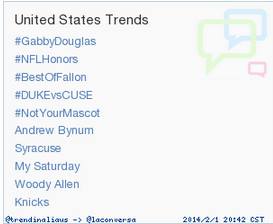
#NotYourMascot trending nationally during 2014 Super Bowl
I disagreed and pointed out that the fight against Native mascotry helped grow the networks (connections with each other, sophisticated use of social media, connections built with media/reporters) that are undergirding the fight against DAPL. And we were able to achieve success (sadly, #NotYourMascot is still the ONLY Native hashtag to trend nationally) because we were affecting something Americans wore on their heads (sports team caps) — something that affects them personally. I know it is a sorry thing to say that concern about Native issues has to start out of self-interest, but that is my observation. And now, we are capitalizing on those connections that were built.


In light of that, I would like to sing the praises of EONM core members of our strategy team who are out there fighting the #NoDAPL fight:


Yolonda BlueHorse protesting at the Dallas-Washington NFL game in Dallas

Yolonda BlueHorse​ (Lakota) in Texas is working with Natives there to keep the #NoDAPL issue in front of Energy Transfer Partner CEO Kelcy Warren's face in his hometown. He agreed to meet with them after they cornered him at a public meeting and abstained from a Texas Parks and Wildlife Commissioner vote on a pipeline because of protests.


Yolonda helping coordinate protests at DAPL owner's Dallas headquarters

Desiree Kane at Oceti Sakowin camp in North Dakota

And Desiree Kane​ (Miwok), who has been living continuously at the camp since July doing the thankless volunteer work that so many are doing who are not in front of the cameras but that is absolutely necessary to make the Oceti Sakowin camp run. Please read her recent piece, "The Standing Rock Victory You Didn’t Hear About" in Yes! Magazine that gives a vision of hope in the midst of all this suffering our people have endured.


Nicky Parkhurst directing EONM's 2015 Super Bowl protest in Phoenix

And Nicky Parkhurst (Diné/Lakota) whose mom's family is from Cannonball and who is fundraising to help her community deal with the fallout of the assaults by the state of North Dakota. Please support her Gofundme!

Native people in the Southwest had strong feelings about being mascotted
Yes, there was a police presence

Nicky's husband supporting his wife


Morning Star (on left) at prayer circle before Washington NFL team protest
And Morning Star Gali​ (Pit River) who is also living at the camp and working hard to revise Executive Order 13007 that provides cultural access and protections for our people. This revision will ensure protection for all threatened sacred sites located on Federally managed lands. Here is a link to the proposal. Please advocate for it!


Morning Star (in skirt) marching outside stadium of Washington-49ers game 
All of these women have been central to the work of EONM. They have stuck by me when others have not. I admire them tremendously. I know they don't want to be singled out — they prefer to do the work that needs to be done and not be on camera.That is our people's way, after all. But they are amazing.


Morning Star's mom demonstrating what a real RedSk*n is to Washington fans


Trolls often chide us that we should work on the "more important issues" and we always say we do it all: #Simultaneously. It's not chance that these women, central to EONM, are also on the frontlines of #NoDAPL. And look at the face of Kelcy Warren, yet another billionaire these amazing Native women have helped put in the hot seat. Priceless.

Energy Transfer Partners CEO Kelcy Warren under pressure

Hechetu Ye (Dakota for this is the truth)


PS: Here is my latest article at TeleSUR English about Standing Rock which is my way of contributing!
SaveSaveSaveSave
SaveSave
SaveSave
SaveSave
SaveSaveSaveSave
Continue Reading
jfkeeler
0 Comments

You Might Also Like