-->

Theme Layout

Boxed or Wide or Framed

Theme Translation

Display Featured Slider

Featured Slider Styles

Display Grid Slider

Grid Slider Styles

Display Trending Posts

Display Author Bio

Display Instagram Footer

Dark or Light Style

Powered by Blogger.

Comments system

top navigation

Labels

Pages

Menu

Pages - Menu

Popular Posts

Blog Archive

Showing posts with label Native American Heritage Month. Show all posts
Why I Write

Why I Write


Last Thursday, I was featured with three other Native writers by Passion Passport as part of Native American Heritage Month. I'm resharing it here because I think the interviewer did a great job capturing why I write. If you'd like to support my work on #GivingTuesday please do check out my Patreon. Also, support all Native journalists by donating to the Native American Journalists Association (of which I am a board member) here.


JACQUELINE KEELER (@JFKEELER)
DINÉ (NAVAJO) AND DAKOTA JOURNALIST

Who she is: “With a Diné mother and a Dakota father, my dual Indigenous cultural backgrounds have always provided me with an alternative way to view the world, both from a historical and a political standpoint. As I note in my piece ‘Thanksgiving and the Hidden Heart of Evil’: ‘As a child of a Native American family, you are part of a very select group of survivors, and I learned that my family possessed some inside knowledge of what really happened when those poor, tired masses [the Pilgrims] came to our homes.’”

What she does: “I write, think, and lecture. In 2017, I also edited a book titled ‘Edge of Morning: Native Voices Speak for the Bears Ears,’ which compiles the works of Native poets, activists, teachers, writers, students, and public officials, and shares their passionate feelings about the Bears Ears.”

Why her work is important: “Writing in mainstream media allows me to put a Native perspective on newsworthy events in front of Americans who have never considered that point of view. It also allows me to intellectually address the issues Native people face and help our people process these experiences. We do not have a media that does this for us, so every article I write is putting ideas in the public sphere that would not normally be there.”

How she thinks society at large can better support Indigenous people: “Publish the writing of Native journalists and pay attention to the issue of sovereignty. Tribes are Indigenous sovereign nations within the United States; they have a federal relationship that includes treaties, which can only be entered into by sovereign nations. We are not a race or minority group — we are citizens of nations that precede and persist through the creation of the colonial state.”
Continue Reading
jfkeeler
0 Comments

You Might Also Like

My First Newsletter 'Make America Native Again' or Happy MANA!

My First Newsletter 'Make America Native Again' or Happy MANA!


This is my first newsletter and it has been quite a learning experience. I have a lot to improve on next month!

Hope you all had a wonderful time with family and friends! Nizhónígo Tązhii Day! 🦃 #NoThankstaking Wopida!

An unusual amount of national media coverage of Native Americans surrounded the 2018 Midterms—which means it was not zero as is what we are accustomed to expect. From the North Dakota ID law to the election of the first two Native congresswomen, Native people were in the news.

Today you can read my analysis on the election in Truthout (see below). Just so you know, my working title was "In Partisan America, the Native American Vote Rules: How A Little Known Demographic Maintains the Balance of Power in Congress." I know, long. You can also hear the KBOO Wednesday Talk Radio show I co-hosted on Native American political and ethical leadership online. The show includes an interview I did with Congresswoman-elect Deb Haaland when she was in Portland. On Thanksgiving Eve, I was on a panel Art & Power: Centering the Voices of Native Artists here at Portland State University. I closed out the evening reading aloud my take on Thanksgiving (see below).

But really, for me, the theme of this month was "Make America Native Again" or MANA for short (and you can buy the hats here). And that began in October as more cities across the country gave up the ghost on Columbus Day in favor of Indigenous Peoples' Day. I examined this in a piece I wrote for Yes! Magazine: Beyond Columbus Day: Changing the Name Is Just the First Step and spoke to Klee Benally on KBOO. He helped organize protests in Flagstaff on Indigenous Peoples' Day. 13 are now facing misdemeanor charges.

In October, I also addressed Senator Elizabeth Warren's announcement of her DNA results (see below) and shared a byline for the first time with Kelly Hayes, (Menominee) for NBC News' THINK (link below). Then I did it again with Terri Hansen, (Ho-Chunk) for a post-election piece for Yes! Magazine “We Are Still Here”: Native Americans Win a Voice in Government. It was wonderful collaborating with both of these talented Native women. I would do it again in a heartbeat.

In November, Edge of Morning: Native Voices Speak for the Bears Ears, a book I edited in 2017 is also having a moment. The book is featured by Powell's City of Books for Native American Heritage Month in their store here in Portland, Oregon (see photo below) with a number of other amazing Native-authored books. The bookstore's blog published an essay I wrote "Trump vs. Bears Ears: Five Tribes Take a Stand for Their Collective Histories on the Land, and the U.S. President Dismantles It." In it, I quoted from my famous (or infamous?) Thanksgiving essay "Thanksgiving and the Hidden Heart of Evil." This bit of writing has been published all over the world in many different languages over the years and was republished in The New York Times last year. Words, it seems, have a life of their own.

I have one more piece to finish writing that is a special request from my uncle, Sam Deloria. He takes issue with the way the word 'tribal' is being used by talking heads on tv when they are discussing the political divide in this country. The working title of my response is "It’s Not Tribalism, Let’s Call It What It is: Terror." And the even longer subtitle is "The American Dream Has Always Been About White Affirmative Action and Terror for Everyone Else."

We'll see if any editor is brave enough to carry it! In any case, happy MANA!

You can read the rest of the Make America Native Again newsletter here. And sign up here.


Continue Reading
jfkeeler
0 Comments

You Might Also Like

Thinking of Thought Woman, Leslie Marmon Silko - Poem of the Day Native American Heritage Month

Thinking of Thought Woman, Leslie Marmon Silko - Poem of the Day Native American Heritage Month


Spiderwoman/Thought Woman. Art by Jade Red Moon.
Leslie Marmon Silko is one of those writers who have contributed to my understanding of the world as a Native American woman.  Some of the passages in her novels read like poetry to me and remind me of the voice of my own Navajo mother.  In fact, writers like Silko and Paula Gunn Allen, Native women of the same generation as my mother have perspectives very similar to those she passed on to me.  

Raised in a still very traditional Navajo culture (my grandparents did not speak English and were completely traditional in both dress and worldview) she and other young Native women of her generation left their respective reservations in the 1960's and 1970's to be greeted by an America that had only recently undergone the Civil Rights Movement and in the midsts of the Women's Rights Movement.  My mother saw in this movement a great deal of her own matrilineal Navajo traditions and threw herself enthusiastically into working for the passage of the Equal Rights Amendment.  It is hard to imagine what it is like to be a young woman, to leave all you know, traditions that are clear and in your favor to enter a world where such surety does not exist.  Not as a brown woman in color conscious society, not as a woman in a society that favors men, not as a traditional Navajo in a Judeo Christian society that knows nothing about your cosmological underpinnings.  So, when she raised me in Suburbia, she took great pains to help me bridge those worlds.  

She was proud that Navajo traditions valued women and that these ideas were now being embraced by Euro-American culture.  She emphasized to me the importance of women and their role in the Navajo concept of the world and told me the stories of Changing Woman and her sister White Shell woman.  She made sure I knew my clans and the stories of my clan - a matrilineal line that stretches back to Changing Woman, herself in Navajo culture.  She told me that my clan the Kinyaani (Towering House People) were the first clan of the Navajo people and the first Kinyaani woman (my many-greats grandmother) was made my Changing Woman herself.  In the songs of my cheii (my grandfather), the chants he constantly sang I could hear the rhythms of a continuity that to this day puts me at ease.  I know things are right, even as he would start singing a chant as my masani (grandmother) lectured him about not doing the dishes the night before.  He would smooth over small mishaps and my mother explained to me that he had turned one of his songs, a riding song (songs sung for riding on horseback) into a powerful prayer.  Navajos do not pray the way European Christians do, "I want this, give me that" but it is instead an imagining of the world as they want it to be: "When I ride I will meet friendly people who will give me water and good food when I stop to talk to them, when I ride home I will have a safe and quick journey back." This is how those songs and prayers went with a tempo of confident, soothing optimism of life which is often translated as Hozho, harmony.  It is in this way that I read Silko's writing and how it speaks to me, even though, she is from another Southwestern people, the Laguna Pueblo, there is a cultural similarity that her words feed and nourish and help me navigate this strange between world we modern Native people live in.


Ceremony 
I will tell you something about stories,"
[he said] 
They aren't just entertainment. 
Don't be fooled. 
They're all we have, you see. 
All we have to fight off illness and death. 
You don't have anything 
if you don't have the stories. 
Their evil is mighty, 
but it can't stand up to our stories. 
So they try to destroy the stories, 
but the stories cannot be confused or forgotten. 
They would like that. 
They would be happy 
because we would be defenseless then.
 [He rubs his belly]
 I keep it in here,
[he said] 
Here, put your hand on it. 
See? 
It is moving. 


Ts' its' tsi' nako, Thought-Woman,
is sitting in her room
and what ever she thinks about
appears.
She thought of her sisters,
Nau' ts' ity' i and I' tcs' i,
and together they created the Universe
this world
and the four worlds below.
Thought-Woman, the spider,
named things and
as she named them
they appeared.
She is sitting in her room
thinking of a story now
I'm telling you the story
she is thinking.
Continue Reading
jfkeeler
1 Comments

You Might Also Like

Jacklight by Louise Erdrich  - Poem a Day for Native American Heritage Month

Jacklight by Louise Erdrich - Poem a Day for Native American Heritage Month


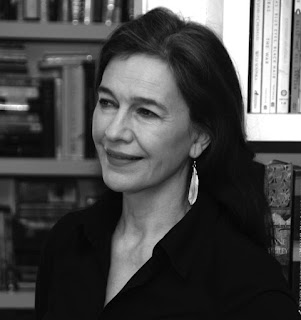
Ojiway poet, Louise Erdrich
I've been thinking about poetry and Native Americans.  I have some favorites and I thought that for the rest of Native American Heritage Month, I'd post a few.  If anyone has any they'd like to suggest please feel free to tell me about your favorite poems in the comments!

My daughter was recently reading my copy of Louise Erdrich's book of poetry Jacklight and so, this poem has been on my mind today.  

Jacklight
The same Chippewa word is used both for flirting and hunting game, while another Chippewa word connotes both using force in intercourse and also killing a bear with one’s hands.             
-R.W. Dunning (1959) Social and Economic Change Among the Northern Ojibwa

We have come to the edge of the words,
out of brown grass where we slept, unseen,
out of knotted twigs, out of leaves creaked shut,
out of hiding.

At first the light wavered, glancing over us.
Then it clenched to a fist of light that pointed,
searched out, divided us.
Each took the beams like direct blows the heart answers.
Each of us moved forward alone.

We have come to the edge of the woods,
drawn out of ourselves by this night sun,
this battery of polarized acids,
that outshines the moon.

We smell them behind it
but they are faceless, invisible.
We smell the raw steel of their gun barrels,
mink oil on leather, their tongues of sour barley.
We smell their mothers buried chin-deep in wet dirt.
We smell their fathers with scoured knuckles,
teeth cracked from hot marrow.
We smell their sisters of crushed dogwood, bruised apples,
of fractured cups and concussions of burnt hooks.

We smell their breath steaming lightly behind the jacklight.
We smell the itch underneath the caked guts on their clothes.
We smell their minds like silver hammers
cocked back, held in readiness
for the first of us to step into the open.

We have come to the edge of the woods,
out of brown grass where we slept, unseen,
out of leaves creaked shut, out of our hiding.
We have come here too long.

It is their turn now,
their turn to follow us. Listen,
they put down their equipment.
It is useless in the tall brush.
And now they take the first steps, not knowing
how deep the woods are and lightless.
How deep the woods are.

-Louise Erdrich (Turtle Mountain Chippewa)

Continue Reading
jfkeeler
0 Comments

You Might Also Like