-->

Theme Layout

Boxed or Wide or Framed

Theme Translation

Display Featured Slider

Featured Slider Styles

Display Grid Slider

Grid Slider Styles

Display Trending Posts

Display Author Bio

Display Instagram Footer

Dark or Light Style

Powered by Blogger.

Comments system

top navigation

Labels

Pages

Menu

Pages - Menu

Popular Posts

Blog Archive

Showing posts with label Navajo. Show all posts
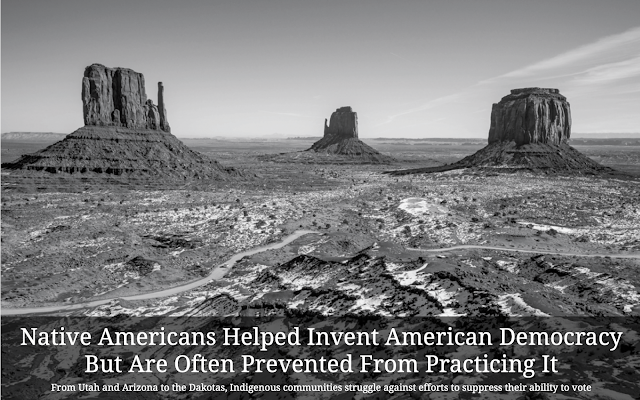
Fundamental Laws and Navajo Voting

Fundamental Laws and Navajo Voting


My latest at Sierra Magazine. Photo: Dustin Wero

"Many Diné I have spoken to over the years have expressed hope that the revival of the Fundamental Law offers us a way to reconnect to the wisdom of our ancestors. Another hope is that our non-Native neighbors and fellow US citizens might find a way to learn from the example of our long-standing values. Among those lessons is the connection between right relationships among people and right relationships to place.
'These lands offer a form of healing that we want people to accept so we can live in harmony together,' Willie Grayeyes once told me, expressing his hope that dominant, white culture might find 'a more harmonious approach than just hit-and-run.'"

My latest article for Sierra Magazine.


Check out my Patreon page, I'll be adding photos of my trip across the Navajo Nation while doing the reporting for this piece. Thank you to Sierra Magazine for supporting my work. 


Continue Reading
jfkeeler
0 Comments

You Might Also Like

Poetically Fighting for Sacred Sites and National Monuments

Poetically Fighting for Sacred Sites and National Monuments


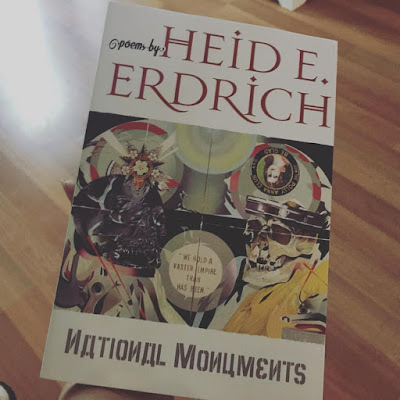
I was happy when my copy of National Monuments by Ojibway poet Heid E. Erdrich came in the mail! The book is perhaps best known for her awesomely comic poems about Kennewick Man dating online, but I was interested in how she handled the issue of sacred cultural sites and how little power Native people have to protect these sites--and how little understood the issue is by the powers that be.

The fight for public lands has been in the news all year since the Bundy's took over Malheur in January and taken a greater urgency on Monday as the GOP voted to include language in it's 2016 Platform to demand Congress "return" federal lands to states immediately.

In contrast, President Obama has been using his executive powers under the Antiquities Act to preserve more and more public land as National Monuments. On Saturday, July 16th, Secretary Jewell will be holding a public meeting in Bluff, Utah on the proposed Bears Ears National Monument, proposed by the Bears Ears Inter-Tribal Coalition. Please attend if you can and share any information coming out of the meeting to your networks via social media. The area of Bears Ears in southeastern Utah, containing more than 100,000 cultural sites, is the most significant unprotected cultural and archaeological area in the US, and sacred ground to the tribes proposing and supporting this national monument.

Also contribute if you can and/or share the Bears Ears anthology "Edge of Morning: Native Voices Speak for the Bears Ears" Kickstarter to help bring greater awareness of Native voices on the issue of preservation of cultural sites.

With that in mind, the two poems that caught my eye--and will be included in the Edge of Morning (thank you Heid!)--are “Guidelines for the Treatment of Sacred Objects” and "The Theft Outright" (shared below).


The Theft Outright


By Heid E. Erdrich

            after Frost


We were the land's before we were.

Or the land was ours before you were a land.
Or this land was our land, it was not your land.

We were the land before we were people,
loamy roamers rising, so the stories go,
or formed of clay, spit into with breath reeking soul—

What's America, but the legend of Rock 'n' Roll?

Red rocks, blood clots bearing boys, blood sands
swimming being from women's hands, we originate,
originally, spontaneous as hemorrhage.

Un-possessing of what we still are possessed by,
possessed by what we now no more possess.

We were the land before we were people,
dreamy sunbeams where sun don't shine, so the stories go,
or pulled up a hole, clawing past ants and roots—

Dineh in documentaries scoff DNA evidence off.
They landed late, but canyons spoke them home.
Nomadic Turkish horse tribes they don't know.

What's America, but the legend of Stop 'n' Go?

Could be cousins, left on the land bridge,
contrary to popular belief, that was a two-way toll.
In any case we'd claim them, give them some place to stay.

Such as we were we gave most things outright
(the deed of the theft was many deeds and leases and claim stakes
and tenure disputes and moved plat markers stolen still today . . .)

We were the land before we were a people,
earthdivers, her darling mudpuppies, so the stories go,
or emerging, fully forming from flesh of earth—

The land, not the least vaguely, realizing in all four directions,
still storied, art-filled, fully enhanced.
Such as she is, such as she wills us to become.

Source: National Monuments (Michigan State University Press, 2008)
SaveSave
Continue Reading
jfkeeler
0 Comments

You Might Also Like

Oregon's Poet Laureate is Hapa Navajo: Elizabeth Woody

Oregon's Poet Laureate is Hapa Navajo: Elizabeth Woody


Elizabeth Woody (Courtesy Oregon Cultural Trust)

I need poetry to live sometimes. Yesterday, I went to Powell's bookstore hungry for it and found three books of poetry that I could not live without. 

One was Harper's Anthology of 20th Century Native American Poetry, the second was Luci Tapahonso's Blue Horses Rush In and the third was by my own state's poet laureate, Elizabeth Woody, Seven Hands, Seven Hearts.

I've been fortunate to meet her a few times since I've lived here in Oregon and hear her read. Like me, she's half Navajo (which I like to call Hapa Navajo) and raised in the Pacific Northwest. She is enrolled in the Warm Springs Tribe here in Oregon (her other half). I admit, reading her work I was immediately drawn to the poems about her Navajo-side. And yet, when I first moved to the Southwest (which is ostensibly my homeland) after college, the lack of water (the Rio Grande was not grand--just a trickle in the desert) was a shock to me and every night, I had intense dreams of salmon swimming in the river I grew up on, the Columbia or as she describes it in her book Chewana. The salmon of my dreams were always showing themselves in close-up with their multi-colored scales glinting as they crowded together into a writhing mass. I was experienced in my dreams fully the fear I had of living in a world without water--an environment so stark that my husband and I used to play a game of chasing rainclouds in our car out in the open desert just outside of Albuquerque. We'd park our car under a particularly dark one overhead and wait for the rain to fall on us. We'd laugh when only a few thick sandy drops would reach us as the rest evaporated in the sky above us never reaching the ground. 

So I connected deeply with her poem "In Memory of Crossing the Columbia" and I'd like to share it here:

In Memory of Crossing the Columbia
For Charlotte Edwards Pitt and Charlotte Agnes Pitt

My board and blanket were Navajo,
but my bed is inside the river.
In the beads of remembrance,
I am her body in my Father's hands.
She gave me her eyes
and the warmth of basalt.
The vertebrae of her back,
my breastplate, the sturdy
belly of mountainside.

"Pahtu," he whispered in her language.
She is the mountain of change.
She is the mountain of women 
who have lain as volcanoes 
before men.

Red, as the women much loved,
she twisted like silvery Chinook
beyond his reach.

Dancing the Woman-Salmon dance,
there is not much time to waste.


This next poem is named after the Navajo city of Chinle. My husband loved the phrase "a River woman walking in dust." This poem captures so well the experience of having ties to two very different lands and to two very different Native nations.


Chinle Summer

Loneliness for me is being the daughter of two landscapes,
distant from the horizon circling me.
The red earth completely round.
The sky a deep bowl of turquoise overhead.
Mother and father. Loneliness
rising up like thunderheads. The rain pours over
the smooth rocks into the canyon that is familiar.

This is the road that leads to my father's home.
After twenty years I stand on the threshold of his mother's hogan.
Grandmother sits in the cool dark, out of the light 
from the door and smoke hole. She talks softly
in the Diné language.

Talking to me as I grew in her warmth, my mother
lowered herself in this canyon, barefoot and unafraid.
She walked miles in high heels to church by this road
that runs alongside Canyon de Chelly.
She was a river woman walking in dust.

The Recumbent Woman whispers inside different languages.
I am one story. Beauty walked South and then North again.
Beauty sparked physical creation.

A strong and wild will draws up the land into the body.
My journey circles back, unraveling, unmaking itself
like the magnificent loom work of my grandmother's center.
My grandfather once told me, "Lizzy, I was busy singing
over there...you were here. So I came home to see you."
Continue Reading
jfkeeler
0 Comments

You Might Also Like

Veteran's Day Part Two: Navajo Perspective on being a Warrior

Veteran's Day Part Two: Navajo Perspective on being a Warrior


Chief Manuelito
After I posted my previous post about Yankton Chief White Swan and the difference between a Soldier and a Warrior, I remembered a story recounted by my Navajo grandmother's aunt, Tiana Bighorse in her book Bighorse the Warrior.  So, here is a second entry on Veteran's Day, this time from my Navajo side of the family.

When Mr. Bighorse is a boy, he goes with his father.  His father teaches him everything that a boy should do to become a man.  And what he shouldn't do.  And his father tells him, 'You will be a brave and be a warrior some day.'  
In Navajo, a warrior means someone who can get through the snowstorm when no one else can.  
In Navajo, a warrior is the one that doesn't get the flu when everyone else does--the only one walking around, making a fire for the sick, giving them medicine, feeding them food, making them strong to fight the flu. 
In Navajo, a warrior is the one who can use words so everyone knows they are part of the same family.  In Navajo, a warrior says what is in the people's hearts.  Talks about what the land means to them.  Brings them together to fight for it. 

Continue Reading
jfkeeler
0 Comments

You Might Also Like