-->

Theme Layout

Boxed or Wide or Framed

Theme Translation

Display Featured Slider

Featured Slider Styles

Display Grid Slider

Grid Slider Styles

Display Trending Posts

Display Author Bio

Display Instagram Footer

Dark or Light Style

Powered by Blogger.

Comments system

top navigation

Labels

Pages

Menu

Pages - Menu

Popular Posts

Blog Archive

On "More Important Things" and #NotYourMascot and #NoDAPL

On "More Important Things" and #NotYourMascot and #NoDAPL


Andre Cramblit, EONM member protesting at a Washington NFL game in Santa Clara, CA in 2014.


During my Native America Calling pre-interview (I was on the show this week talking about Cleveland at the World Series) the host asked me about criticism that EONM's success with our hashtag #NotYourMascot took away from other "more important" movements.

1656371_10201945243289799_384038065_n.jpg
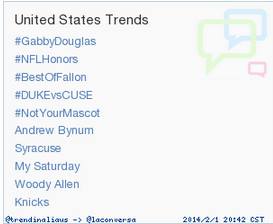
#NotYourMascot trending nationally during 2014 Super Bowl
I disagreed and pointed out that the fight against Native mascotry helped grow the networks (connections with each other, sophisticated use of social media, connections built with media/reporters) that are undergirding the fight against DAPL. And we were able to achieve success (sadly, #NotYourMascot is still the ONLY Native hashtag to trend nationally) because we were affecting something Americans wore on their heads (sports team caps) — something that affects them personally. I know it is a sorry thing to say that concern about Native issues has to start out of self-interest, but that is my observation. And now, we are capitalizing on those connections that were built.


In light of that, I would like to sing the praises of EONM core members of our strategy team who are out there fighting the #NoDAPL fight:


Yolonda BlueHorse protesting at the Dallas-Washington NFL game in Dallas

Yolonda BlueHorse​ (Lakota) in Texas is working with Natives there to keep the #NoDAPL issue in front of Energy Transfer Partner CEO Kelcy Warren's face in his hometown. He agreed to meet with them after they cornered him at a public meeting and abstained from a Texas Parks and Wildlife Commissioner vote on a pipeline because of protests.


Yolonda helping coordinate protests at DAPL owner's Dallas headquarters

Desiree Kane at Oceti Sakowin camp in North Dakota

And Desiree Kane​ (Miwok), who has been living continuously at the camp since July doing the thankless volunteer work that so many are doing who are not in front of the cameras but that is absolutely necessary to make the Oceti Sakowin camp run. Please read her recent piece, "The Standing Rock Victory You Didn’t Hear About" in Yes! Magazine that gives a vision of hope in the midst of all this suffering our people have endured.


Nicky Parkhurst directing EONM's 2015 Super Bowl protest in Phoenix

And Nicky Parkhurst (Diné/Lakota) whose mom's family is from Cannonball and who is fundraising to help her community deal with the fallout of the assaults by the state of North Dakota. Please support her Gofundme!

Native people in the Southwest had strong feelings about being mascotted
Yes, there was a police presence

Nicky's husband supporting his wife


Morning Star (on left) at prayer circle before Washington NFL team protest
And Morning Star Gali​ (Pit River) who is also living at the camp and working hard to revise Executive Order 13007 that provides cultural access and protections for our people. This revision will ensure protection for all threatened sacred sites located on Federally managed lands. Here is a link to the proposal. Please advocate for it!


Morning Star (in skirt) marching outside stadium of Washington-49ers game 
All of these women have been central to the work of EONM. They have stuck by me when others have not. I admire them tremendously. I know they don't want to be singled out — they prefer to do the work that needs to be done and not be on camera.That is our people's way, after all. But they are amazing.


Morning Star's mom demonstrating what a real RedSk*n is to Washington fans


Trolls often chide us that we should work on the "more important issues" and we always say we do it all: #Simultaneously. It's not chance that these women, central to EONM, are also on the frontlines of #NoDAPL. And look at the face of Kelcy Warren, yet another billionaire these amazing Native women have helped put in the hot seat. Priceless.

Energy Transfer Partners CEO Kelcy Warren under pressure

Hechetu Ye (Dakota for this is the truth)


PS: Here is my latest article at TeleSUR English about Standing Rock which is my way of contributing!
SaveSaveSaveSave
SaveSave
SaveSave
SaveSave
SaveSaveSaveSave
Continue Reading
jfkeeler
0 Comments

You Might Also Like

Preserving Indigenous Cultures and Indigenous Spaces- Edge of Morning: Native Voices Speak for Bears Ears

Preserving Indigenous Cultures and Indigenous Spaces- Edge of Morning: Native Voices Speak for Bears Ears


Please support the Edge of Morning Kickstarter here: http://kck.st/295SZfi


What is the value of culture versus the resources that can be exploited from the land? This is at heart the question raised when Indigenous peoples lay claim to the land because of their cultural connection to it--often in defiance of corporate and settler colonial desires to fully exploit the resources of that land. What is the best use of the land by human beings? Is it the cultural heritage of the Indigenous people or is it the successful exploitation of the oil, coal, water, etc. to create wealth?

This is at heart the question posed by the unique proposal brought forward by five Native American nations, Indigenous grassroots community members and environmentalists. What value does the past hold? Does it matter that antiquities and ancient sites be undisturbed? Is there more value in mining and the right to ride ATV’s over thousands of archaeological sites?

Jonah Yellowman, Utah Diné Bikeyah
“We're here to look after it, we're here to preserve it. When our medicine people, when they go to get something for a to do a ceremony they go there and either talk to the plant or whatever they're going to use, either they're going to cut it, they always put corn pollen there, they put it back together. Wherever they dig around, they smooth it out. Leave it like the way it is they walk away from it. We don't just dig it out and leave a big hole. We don't do that. So that's how we are as Native American Indian people.We are here to take care of it. If you take care of it and look after it--it's going to take care of you. You're going to be healed from it. It's going to heal the land, too.”
Jonah Yellowman, Diné, Utah Dine Bikeyah, spiritual advisor

And not only are 100,000 archaeological sites endangered, but so is Navajo (Diné) culture. The Navajo Nation is one of the largest Native Nations within the United States. Its landbase is the size of Ireland; it has 350,000 members--a population equal to that of Iceland; it is also larger than more than 20 member states of the United Nations. Over 125,000 Navajos speak their language fluently--the most of any Indigenous language in the United States. However, the culture depends on isolated communities like those found in San Juan County, Utah to continue to survive.

Navajo Community members at Bears Ears

Traditional Navajo communities and their elders have borne the brunt of energy development in the Southwest since World War II when the Navajo Nation’s uranium resources were used to win the war. To this day there are hundreds of open uranium mines that have not been cleaned up, which poison the water and health of the  people. At Black Mesa, coal strip mining has led to the forced removal of thousands of more traditional Navajo. Many families were “relocated” to the Puerco River, the site of the largest uranium spill in U.S. history. The coal is transported by slurrying a process draining precious  drinking water from the Navajo-Hopi aquifer--the only slurry line in North America. The Public Lands Initiative presented by Rep. Bishop (R-Utah) in congress this week, will open up more Navajo communities to be the victimized by mining.

Putting a Price on Cultural Exchange

And what value do intact culturally-intact Navajo communities provide to America? One need only look at American history to see the huge impact that cultural exchanges between American colonists and intact Indigenous nations like the once powerful Iroquois Confederacy gave to the world.

Modern Democracy--the product of cultural exchange

It has been well-documented that it was the Iroquois that urged the 13 colonies to unite like the 6 nations of their confederacy had done to bring peace and stability to the region. The Great Law of Peace of the Haudenosaunee (Iroquois) was also a living example the colonists could see first hand of a working democratic government.

Women’s Rights

It is no accident that the first women’s rights conference was held in Seneca Falls, New York--adjacent to a Seneca village. The Seneca were one of the 6 nations of the Iroquois Confederacy. White women observed daily the greater rights Iroquois women enjoyed. At a time when American women were legally dead, the Iroquois Confederacy, which was matrilineal and ultimate power over the leadership was held by clan mothers, was a vision of another world for European American women. The exchange gave them the courage to challenge thousands of years of patriarchy that dehumanized women. In their speeches, Elizabeth Cady Stanton and Lucretia Mott exclaimed that they wanted the rights they saw Seneca women had.

So what is the value of such exchanges with Indigenous cultures? Cultures that contain ideas long lost in the rest of the world? As seen by these two examples, the exchange produced ideas that have made lives better for literally billions of people in the world.

What cultural ideas exist in traditional Navajo communities? The land contains not only beauty, history, and energy resources, but the cultural resources that represent human intelligence and the source of ideas that make life better in ways we cannot predict today.

In light of this, the Edge of Morning looks at the work of Native Americans to fight for their cultural places and spaces both at the grassroots level at Bears Ears (Origin Stories - Interviews with Bears Ears Intertribal Coalition organizers) and by Navajo activists and thinkers across the Navajo Nation (For this Land, For the Diné Bikéyah – The People’s Land - Navajo Activists and Academia Speak for Bears Ears), but across the United States (“In Our Usual and Accustomed Places” - Indigenous leaders on Bears Ears and the Fight for Cultural Preservation and Access to Public Lands in the United States).

The fight for our traditional communities and cultural access to our traditional homelands and sacred sites is a monumental effort being conducted by Indigenous communities in a variety of ways. Bears Ears is unique and promising by being such a unified effort by several different Indigenous Nations. It is also unique in the creation of a national monument proposal that represents an unusual degree of collaboration with Indigenous communities.

National Monuments are meant to celebrate the beauty and richness of the our American experience--and nothing encapsulates that more than the cultural exchange with Indigenous people and the gifts that exchange has given to the world.

SaveSave
Continue Reading
jfkeeler
0 Comments

You Might Also Like

Poetically Fighting for Sacred Sites and National Monuments

Poetically Fighting for Sacred Sites and National Monuments


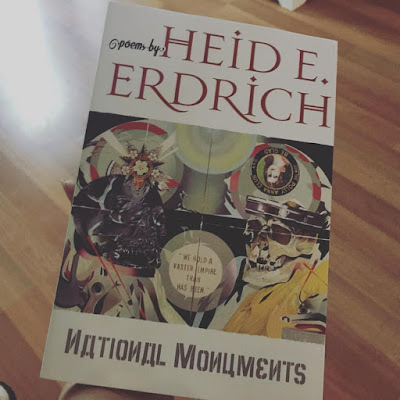
I was happy when my copy of National Monuments by Ojibway poet Heid E. Erdrich came in the mail! The book is perhaps best known for her awesomely comic poems about Kennewick Man dating online, but I was interested in how she handled the issue of sacred cultural sites and how little power Native people have to protect these sites--and how little understood the issue is by the powers that be.

The fight for public lands has been in the news all year since the Bundy's took over Malheur in January and taken a greater urgency on Monday as the GOP voted to include language in it's 2016 Platform to demand Congress "return" federal lands to states immediately.

In contrast, President Obama has been using his executive powers under the Antiquities Act to preserve more and more public land as National Monuments. On Saturday, July 16th, Secretary Jewell will be holding a public meeting in Bluff, Utah on the proposed Bears Ears National Monument, proposed by the Bears Ears Inter-Tribal Coalition. Please attend if you can and share any information coming out of the meeting to your networks via social media. The area of Bears Ears in southeastern Utah, containing more than 100,000 cultural sites, is the most significant unprotected cultural and archaeological area in the US, and sacred ground to the tribes proposing and supporting this national monument.

Also contribute if you can and/or share the Bears Ears anthology "Edge of Morning: Native Voices Speak for the Bears Ears" Kickstarter to help bring greater awareness of Native voices on the issue of preservation of cultural sites.

With that in mind, the two poems that caught my eye--and will be included in the Edge of Morning (thank you Heid!)--are “Guidelines for the Treatment of Sacred Objects” and "The Theft Outright" (shared below).


The Theft Outright


By Heid E. Erdrich

            after Frost


We were the land's before we were.

Or the land was ours before you were a land.
Or this land was our land, it was not your land.

We were the land before we were people,
loamy roamers rising, so the stories go,
or formed of clay, spit into with breath reeking soul—

What's America, but the legend of Rock 'n' Roll?

Red rocks, blood clots bearing boys, blood sands
swimming being from women's hands, we originate,
originally, spontaneous as hemorrhage.

Un-possessing of what we still are possessed by,
possessed by what we now no more possess.

We were the land before we were people,
dreamy sunbeams where sun don't shine, so the stories go,
or pulled up a hole, clawing past ants and roots—

Dineh in documentaries scoff DNA evidence off.
They landed late, but canyons spoke them home.
Nomadic Turkish horse tribes they don't know.

What's America, but the legend of Stop 'n' Go?

Could be cousins, left on the land bridge,
contrary to popular belief, that was a two-way toll.
In any case we'd claim them, give them some place to stay.

Such as we were we gave most things outright
(the deed of the theft was many deeds and leases and claim stakes
and tenure disputes and moved plat markers stolen still today . . .)

We were the land before we were a people,
earthdivers, her darling mudpuppies, so the stories go,
or emerging, fully forming from flesh of earth—

The land, not the least vaguely, realizing in all four directions,
still storied, art-filled, fully enhanced.
Such as she is, such as she wills us to become.

Source: National Monuments (Michigan State University Press, 2008)
SaveSave
Continue Reading
jfkeeler
0 Comments

You Might Also Like

Oregon's Poet Laureate is Hapa Navajo: Elizabeth Woody

Oregon's Poet Laureate is Hapa Navajo: Elizabeth Woody


Elizabeth Woody (Courtesy Oregon Cultural Trust)

I need poetry to live sometimes. Yesterday, I went to Powell's bookstore hungry for it and found three books of poetry that I could not live without. 

One was Harper's Anthology of 20th Century Native American Poetry, the second was Luci Tapahonso's Blue Horses Rush In and the third was by my own state's poet laureate, Elizabeth Woody, Seven Hands, Seven Hearts.

I've been fortunate to meet her a few times since I've lived here in Oregon and hear her read. Like me, she's half Navajo (which I like to call Hapa Navajo) and raised in the Pacific Northwest. She is enrolled in the Warm Springs Tribe here in Oregon (her other half). I admit, reading her work I was immediately drawn to the poems about her Navajo-side. And yet, when I first moved to the Southwest (which is ostensibly my homeland) after college, the lack of water (the Rio Grande was not grand--just a trickle in the desert) was a shock to me and every night, I had intense dreams of salmon swimming in the river I grew up on, the Columbia or as she describes it in her book Chewana. The salmon of my dreams were always showing themselves in close-up with their multi-colored scales glinting as they crowded together into a writhing mass. I was experienced in my dreams fully the fear I had of living in a world without water--an environment so stark that my husband and I used to play a game of chasing rainclouds in our car out in the open desert just outside of Albuquerque. We'd park our car under a particularly dark one overhead and wait for the rain to fall on us. We'd laugh when only a few thick sandy drops would reach us as the rest evaporated in the sky above us never reaching the ground. 

So I connected deeply with her poem "In Memory of Crossing the Columbia" and I'd like to share it here:

In Memory of Crossing the Columbia
For Charlotte Edwards Pitt and Charlotte Agnes Pitt

My board and blanket were Navajo,
but my bed is inside the river.
In the beads of remembrance,
I am her body in my Father's hands.
She gave me her eyes
and the warmth of basalt.
The vertebrae of her back,
my breastplate, the sturdy
belly of mountainside.

"Pahtu," he whispered in her language.
She is the mountain of change.
She is the mountain of women 
who have lain as volcanoes 
before men.

Red, as the women much loved,
she twisted like silvery Chinook
beyond his reach.

Dancing the Woman-Salmon dance,
there is not much time to waste.


This next poem is named after the Navajo city of Chinle. My husband loved the phrase "a River woman walking in dust." This poem captures so well the experience of having ties to two very different lands and to two very different Native nations.


Chinle Summer

Loneliness for me is being the daughter of two landscapes,
distant from the horizon circling me.
The red earth completely round.
The sky a deep bowl of turquoise overhead.
Mother and father. Loneliness
rising up like thunderheads. The rain pours over
the smooth rocks into the canyon that is familiar.

This is the road that leads to my father's home.
After twenty years I stand on the threshold of his mother's hogan.
Grandmother sits in the cool dark, out of the light 
from the door and smoke hole. She talks softly
in the Diné language.

Talking to me as I grew in her warmth, my mother
lowered herself in this canyon, barefoot and unafraid.
She walked miles in high heels to church by this road
that runs alongside Canyon de Chelly.
She was a river woman walking in dust.

The Recumbent Woman whispers inside different languages.
I am one story. Beauty walked South and then North again.
Beauty sparked physical creation.

A strong and wild will draws up the land into the body.
My journey circles back, unraveling, unmaking itself
like the magnificent loom work of my grandmother's center.
My grandfather once told me, "Lizzy, I was busy singing
over there...you were here. So I came home to see you."
Continue Reading
jfkeeler
0 Comments

You Might Also Like

Washington Post 'Redskins' Poll and Who is Native American?

Washington Post 'Redskins' Poll and Who is Native American?


Native family at an anti-Redsk*ns protestors in Minneapolis in 2014--Washington Post poll claims they and the 5,000 others Natives at this protest were an aberration in their community.
I have been pushing for more of a political definition of Native American identity in line with nationality for several years now. I think it is the fuzziness of Native American identity that makes it so easy to assume by others. It also causes a great deal of distress to Native youth. The fact is, any American can walk up to a Native person and tell them they are “not Native enough” to suit them. It happens all the time and this is traumatizing to youth and adults.

This identity “fuzziness” was purposefully done and is the result of hundreds of years of policy carried out by both colonial and U.S. governments to erase the political existence of Native American nations. These Indigenous nations because they have claims to the land and resources constitute a very real threat to the political integrity of the United States and any settler colonial state. So our true identity as pre-existing and persisting nations of North America is clouded as a matter of national policy.

This policy is evident in the denial of infrastructure to our remaining sovereign lands which drives Native families from their homelands to seek economic and educational opportunity. It can also be seen in the wholesale remove of Native youth from their families, both in the boarding school years and now, under the guise of foster care and adoption. The mass removal of children from an ethnic group constitutes an act of genocide under the Geneva Convention.

The pollsters could have also used the definition the United Nations and the International Labour Organization have outlined a few characteristics of an Indigenous person:

● Descended from the pre-colonial/pre-invasion inhabitants of a region.
● Maintain a close tie to land and both cultural and economic practices.
● Suffer from economic and political marginalization as a minority group.
● A group is considered Indigenous if it defines itself that way.

Native protestors at a Washington Redsk*ns game in Santa Clara, California
The survey would also have had to provide proper line of questioning to be certain that the respondents’ understanding of Native American identity is what the pollsters mean. This was not done and the Post editor who answered our questions before The Nation article came out stated that he did not believe anyone would lie about their identity, so they certainly did not structure the survey for that contingency.

I think this whole poll brings to light very clearly the nature of misrepresentation of Native people in the United States. It also shows how far apart we are that '9 out of 10’ would seem remotely credible to the Washington Post staff.

Continue Reading
jfkeeler
0 Comments

You Might Also Like